
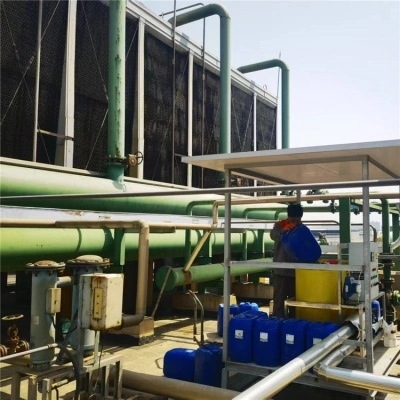
What Is Polyacrylic Acid (PAA) Dispersant?
Polyacrylic Acid (PAA) is a classic anionic polymer water treatment chemical with the CAS number 9003-01-4. As a water-soluble homopolymer of acrylic monomers, it features stable molecular structure, excellent hydrophilicity, and strong particle adsorption capacity. Different from traditional single-function antiscalants, PAA dispersant focuses on suspending and dispersing fine particles rather than simply inhibiting scale crystallization.
When added to circulating water, PAA molecules adsorb onto the surface of calcium carbonate, calcium sulfate, silt, rust powder, and suspended impurities. It changes particle surface charge and spatial structure, preventing microcrystal agglomeration and wall adhesion. All fine pollutants remain stably suspended in water and are discharged with water flow, achieving continuous self-cleaning and scale prevention for circulating water systems.
Core Working Mechanism of PAA Dispersant
-
Electrostatic Repulsion Dispersion PAA polymer carries anionic charges in water. It adsorbs on the surface of suspended scale microcrystals and silt particles, making particles uniformly negatively charged. Mutual electrostatic repulsion keeps particles dispersed without agglomeration or precipitation, avoiding sludge deposition at the bottom of cooling towers and pipelines.
-
Crystal Distortion & Scale Inhibition PAA molecules embed in the growth interface of mineral crystals, destroying the regular lattice structure of calcium and magnesium scale crystals. It turns hard, dense scale into loose, amorphous micro-particles that are not easy to adhere to metal walls, fundamentally inhibiting hard scale formation.
-
Steric Stabilization Effect The polymer molecular chain forms a protective layer on the particle surface, generating steric barrier to prevent particle collision and aggregation. It maintains long-term uniform dispersion of circulating water and avoids local fouling and pipeline blockage.
Key Features & Industrial Advantages
-
Powerful Universal Dispersion Performance Effectively dispenses various impurities in circulating water, including calcium carbonate scale, calcium sulfate scale, silicate microcrystals, industrial silt, rust sediments, and organic suspended matter. It solves the common problems of turbidity, sludge accumulation, and pipeline fouling in industrial water systems.
-
Excellent High & Alkaline Water Adaptability PAA maintains stable chemical activity under high temperature, high hardness, and high alkalinity working conditions. It adapts to high-concentration multiple operation of industrial circulating water, without decomposition or failure, suitable for harsh industrial water quality environments that ordinary dispersants cannot handle.
-
Improve Heat Exchange Efficiency & Save Energy Long-term use of PAA dispersant prevents scale and sludge coverage on heat exchangers, condensers, and boiler walls. It eliminates thermal resistance loss, restores equipment heat conduction performance, and effectively reduces HVAC and industrial equipment energy consumption.
-
Non-Phosphorus & Eco-Friendly Formula As a non-phosphorus polymer agent, PAA avoids eutrophication and algae breeding caused by phosphorus-containing water treatment chemicals. It features low toxicity, easy biodegradation, and compliant discharge, meeting global environmental protection and industrial water treatment standards.
-
Multi-Metal System Compatibility Stable and safe for carbon steel, stainless steel, copper, aluminum, and galvanized pipeline equipment. It does not cause metal corrosion, pitting, or pipeline aging, and can be used synergistically with corrosion inhibitors and bactericides without adverse reactions.
-
High Cost-Performance & Low Dosage High-purity polymer raw material provides high dispersion efficiency with low dosing concentration. It replaces multiple traditional dispersants and antiscalants, greatly reducing overall water treatment operation and maintenance costs.
-
Stable Long-Term Water Quality Maintenance Continuous dispersion avoids repeated scaling and sludge accumulation, extending the system cleaning cycle. It reduces manual cleaning, equipment shutdown losses, and pipeline maintenance frequency.
Main Industrial & Commercial Application Scenarios
Polyacrylic Acid (PAA) dispersant is one of the most versatile water treatment chemicals, widely used in all types of open and closed industrial circulating water systems:
1. HVAC Cooling Tower Circulating Water Systems
Ideal for central air conditioning cooling water and chilled water systems in shopping malls, hotels, office buildings, and commercial complexes. PAA disperses cooling tower silt, scale microcrystals, and dust impurities, prevents condenser and evaporator fouling, and stabilizes HVAC cooling efficiency throughout the year.
2. Industrial Boiler & Heating Water Systems
Suitable for steam boilers and hot water boiler circulating water treatment. It inhibits high-temperature hard scale formation and suspended sludge deposition inside boilers, prevents local overheating and tube burst risks, and improves boiler thermal efficiency and operational safety.
3. Chemical Plant Process Circulating Water
Chemical industrial water features complex water quality and high impurity content. PAA stably disperses chemical precipitates, inorganic silt, and reaction by-products, protects heat exchangers and reaction cooling systems from fouling and blockage, and ensures continuous and stable chemical production.
4. Petroleum & Oilfield Water Injection Systems
Used for oilfield water injection and petroleum processing cooling circulating water. It inhibits mineral scaling and particle deposition in long-distance pipelines, prevents pipeline blockage and pressure drop failure, and maintains smooth operation of oilfield water delivery systems.
5. Steel Plant Industrial Cooling Water
Steel factory circulating water contains a large amount of metal oxide powder and industrial dust. PAA efficiently disperses metal sludge and scale particles, avoids pipeline sludge deposition and fouling corrosion, and adapts to long-cycle operation of heavy industrial water systems.
6. Power Plant & Industrial Manufacturing Water Systems
Widely applied in power generation, textile, pharmaceutical, and food processing factory circulating water systems. It maintains clean water quality, stabilizes heat exchange equipment performance, and reduces equipment failure rates caused by fouling and scaling.
Problems Caused Without PAA Dispersant Treatment
-
Sludge & Scale Accumulation: Suspended particles agglomerate and settle to form thick fouling on equipment walls
-
Declined Heat Exchange Efficiency: Scale thermal resistance leads to increased energy consumption
-
Pipeline Blockage & Pressure Imbalance: Sludge deposition narrows pipeline diameter and affects water circulation
-
Accelerated Equipment Corrosion: Scale covering causes oxygen concentration difference corrosion
-
Frequent Manual Cleaning & High Maintenance Costs: Short cleaning cycles increase operational losses
Why Choose Our Polyacrylic Acid (PAA) Dispersant?
-
Industrial-Grade High Purity: Stable molecular weight, consistent dispersion and scale inhibition performance
-
Strong Adaptability: Suitable for high-temperature, high-hardness, alkaline complex water quality
-
Eco-Friendly Non-Phosphorus Formula: Compliant with international environmental discharge standards
-
Multi-System Universal: Compatible with HVAC, boiler, chemical, steel and petroleum water systems
-
Synergistic Compatibility: Works well with corrosion inhibitors, bactericides and other water treatment agents
-
Complete Export Support: Provide SDS, technical datasheets and full set of export certification documents
Final Thoughts
Polyacrylic Acid (PAA) dispersant is a fundamental and essential water treatment chemical for industrial circulating water systems. Its powerful dispersion, crystal distortion and anti-fouling capabilities solve core problems such as particle deposition, sludge accumulation and scale formation. Long-term standardized dosing effectively stabilizes water quality, reduces energy consumption, and extends the service life of heat exchange equipment and pipeline systems, bringing long-term economic benefits for industrial and commercial water treatment projects.