
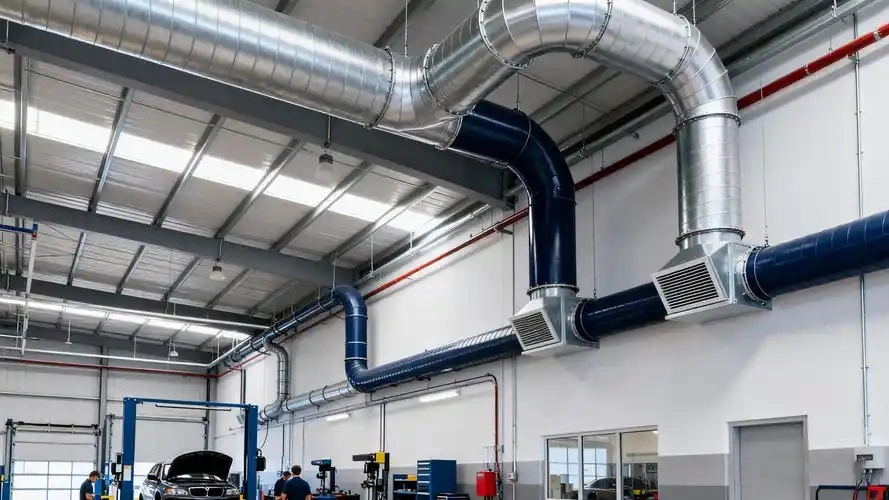
What Is a Fire Damper?
A fire damper is a fire-rated mechanical duct fitting installed at positions where ventilation ducts penetrate fire walls, floor slabs, and fire barriers. It consists of fire-proof blades, stainless steel spring reset structures, and fusible link thermal control components. Under normal operating conditions, the blades remain fully open to ensure unobstructed ventilation airflow.
When a fire occurs and the ambient temperature reaches the rated threshold (usually 70°C/165°F), the fusible link melts automatically. The spring-driven blades close tightly in an instant, completely cutting off the duct passage. This effectively blocks the spread of high-temperature flames, hot air, and combustible smoke, maintaining the integrity of building fire compartments and preventing fire escalation.
As a key passive fire protection product, fire dampers are strictly tested and certified in accordance with UL 555, IBC, and international mechanical code standards, serving as essential safety components for qualified HVAC engineering acceptance.
Main Types of Fire Dampers & Working Scenarios
-
Static Fire Damper The most widely used basic type, suitable for conventional ventilation and air supply ducts. It closes automatically by fusible link temperature sensing in fire conditions, applicable for systems that stop ventilation during fire emergencies. Ideal for general commercial building HVAC systems.
-
Dynamic Fire Damper Adapts to dynamic wind pressure environments where ventilation fans keep running during fires. It maintains reliable tight closing under positive airflow pressure, specially designed for high-air-volume and high-pressure ventilation systems in large industrial buildings.
-
Motorized Fire Damper Equipped with electric actuators, supporting both temperature-sensing automatic closing and remote manual/BA system linkage control. It realizes intelligent fire isolation and system interlocking, widely used in intelligent buildings and high-standard fire protection projects.
-
Combination Fire & Smoke Damper Integrates dual functions of flame isolation and smoke prevention. It can block both high-temperature flames and cold smoke spread, meeting higher fire safety standards, and is commonly used in hospitals, subway stations, and high-rise public buildings.
Core Functions & Engineering Advantages
-
Block Flame & Heat Spread Effectively Fire dampers isolate fire compartments by closing duct passages, preventing flames and high-temperature hot gas from spreading to safe areas along ventilation pipelines. They avoid large-area fire spread caused by duct flue effect, greatly reducing building fire hazards.
-
Meet International Fire Code Compliance All building duct penetration positions require fire damper installation per IBC, IMC, and UL standards. Standardized installation ensures project fire inspection acceptance pass rate, solving compliance risks for HVAC engineering projects.
-
Protect Personnel Evacuation Safety By restraining fire and smoke spread speed, fire dampers extend the safe evacuation time of personnel in buildings, reduce casualties caused by smoke inhalation and flame spreading, and improve building overall fire safety performance.
-
Durable Fire-Rated Structure Made of thickened galvanized steel or stainless steel with high-temperature resistant fire-proof blades. The overall structure is anti-rust, anti-corrosion, and deformation-resistant, maintaining stable fire resistance performance for long-term building operation.
-
Automatic & Reliable Triggering High-sensitivity fusible link thermal sensing device ensures accurate temperature triggering, rapid closing, and tight sealing. No manual operation is required, achieving 24-hour passive fire protection with extremely low failure rate.
-
No Impact on Daily Ventilation The fully open blade design features low air resistance and no wind noise during normal operation, ensuring the original ventilation efficiency and comfort of the HVAC system without daily operation impact.
-
Easy Installation & Low Maintenance Standard modular structure matches all square and round duct specifications. It is easy to install and fix, with simple daily inspection and maintenance, suitable for large-scale building engineering construction.
Typical Industrial & Commercial Application Scenarios
Fire dampers are standard mandatory accessories for all building ventilation duct systems, covering commercial, public, industrial, and intelligent building fields:
1. High-Rise Commercial Building HVAC Systems
High-rise buildings such as office buildings, shopping malls, hotels, and apartments have dense duct networks and large personnel flow. Fire dampers are installed at duct wall and floor penetration positions to block vertical and horizontal fire spread, ensuring high-rise building fire safety and meeting fire acceptance standards.
2. Hospital & Medical Facility Ventilation
Medical places such as wards, operating rooms, and intensive care units have extremely strict fire safety requirements. Fire and smoke combination dampers effectively isolate fire and smoke, protect patients and medical equipment, and ensure the safe operation of medical building systems.
3. Industrial Factory Ventilation & Exhaust Systems
Industrial plants, chemical factories, and processing workshops have flammable materials and complex ventilation systems. Dynamic fire dampers adapt to industrial high-air-volume exhaust environments, prevent fire spread along oil fume and dust exhaust ducts, and reduce industrial production fire risks.
4. Public Transportation & Infrastructure
Subway stations, airports, exhibition halls, and stadiums belong to high-density public places. Standard fire damper installation ensures rapid fire isolation in emergencies, guarantees public personnel evacuation safety, and meets national and international public building fire protection codes.
5. Intelligent Building & BA Linked Systems
Motorized fire dampers cooperate with building automation and fire alarm systems to realize linkage closing. They achieve intelligent fire monitoring and automatic protection, suitable for high-end office buildings and smart park construction.
6. School & Public Welfare Buildings
Campuses, libraries, and community public buildings require stable and reliable passive fire protection. Fire dampers provide long-term stable safety guarantees for public welfare buildings with low maintenance costs and high safety coefficients.
Hidden Risks Without Standard Fire Damper Installation
-
Rapid Fire Spread Through Ducts: Ducts become fire channels, causing rapid fire expansion
-
Failed Fire Inspection & Project Non-Compliance: Unqualified HVAC engineering affects project delivery
-
Shortened Evacuation Time: Fast smoke spread increases personnel safety risks
-
Secondary Building Damage: Long-distance flame spread expands fire loss scope
-
Potential Safety Liability Risks: Non-standard fire protection leads to operational safety hazards
Why Choose Our Fire Dampers?
-
Standard Fire-Rated Performance: Strictly manufactured per international fire codes, stable fire resistance integrity
-
High-Quality Steel Structure: Thickened galvanized steel frame, rust-proof, durable, long service life
-
Sensitive & Reliable Triggering: Standard fusible link, accurate temperature sensing, tight closing
-
Multiple Type Options: Static, dynamic, motorized, fire/smoke combined types for all scenarios
-
Full Size Customization: Square/round dampers, complete specifications for all duct systems
-
Complete Export Certification: Support third-party testing, provide full export documents
Final Thoughts
Fire dampers are indispensable passive fire protection components in modern HVAC and ventilation engineering. They solve the core safety pain point of fire spread along duct networks, maintain building fire compartment integrity, and ensure project fire compliance and long-term safe operation. Standardized selection and installation of high-quality fire dampers are the basic guarantees for high-quality HVAC engineering and building safety management.