
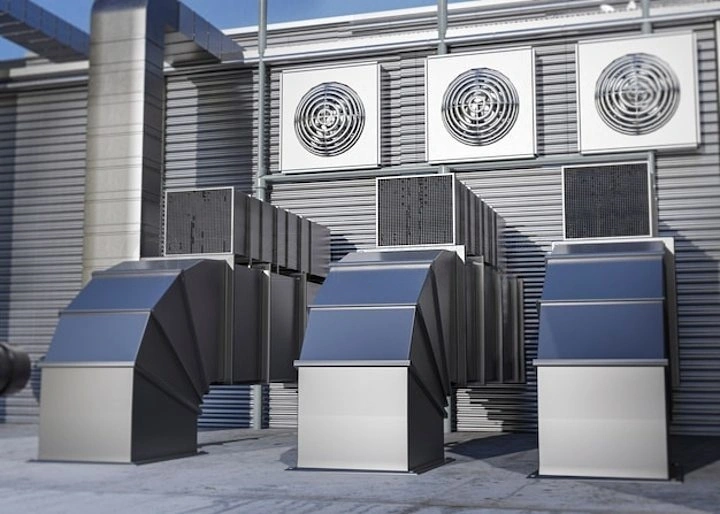
What Is a Sound Attenuation Elbow?
A Sound Attenuation Elbow is a specially acoustically treated duct bend component designed for 90-degree or customized angle airflow turning. Different from ordinary bare metal elbows, its inner wall is lined with high-density flame-retardant sound-absorbing materials, equipped with aerodynamic acoustic turning vanes in high-spec models. While changing the airflow direction, it absorbs and attenuates airflow noise, fan resonance, and turbulent noise across medium and high frequencies.
It integrates the functions of a standard duct elbow and a mini duct silencer in one compact unit. It avoids the need for separate straight silencer sections, greatly saving mechanical space. It is the optimal noise-reduction solution for narrow ceiling cavities, equipment room ducts, and retrofit projects where long straight silencers cannot be installed.
Core Working Principle
-
Multi-Band Acoustic Absorption The internal high-density sound-absorbing lining efficiently absorbs medium and high-frequency wind noise and duct resonance noise generated during airflow turning. The unique bending structure changes the sound wave propagation path, enabling multiple reflections and energy dissipation inside the elbow, realizing efficient noise attenuation of 6–12dB under standard working conditions.
-
Aerodynamic Turning Vane Optimization Built-in streamlined turning vanes balance airflow distribution, eliminate turbulent flow and airflow separation at the bending section. It reduces secondary noise caused by airflow impact while ensuring smooth ventilation, avoiding the sharp wind resistance rise of traditional bare elbows.
-
Vibration & Noise Isolation The integral sealed acoustic structure blocks the outward transmission of fan vibration noise along the duct wall. It suppresses duct-borne noise propagation, preventing mechanical noise from diffusing into indoor occupied areas.
Key Features & HVAC Engineering Advantages
-
Dual-Function Space-Saving Design Combines airflow direction change and noise reduction in one component, replacing ordinary elbows and independent straight silencers. It saves valuable ceiling and mechanical floor space, simplifies duct layout, and shortens construction cycles, especially suitable for compact building ventilation systems.
-
Efficient Broadband Noise Reduction Effectively attenuates airflow turbulence noise, fan operating noise, and duct resonance noise. It solves the problem of obvious background noise in air supply and return air terminals, greatly improving indoor environmental comfort without affecting ventilation efficiency.
-
Low Air Resistance & Stable Ventilation Optimized internal aerodynamic structure minimizes wind resistance increase. Equipped with turning vanes to avoid airflow dead zones and turbulent flow, ensuring the HVAC system maintains designed air volume and wind pressure, with no impact on refrigeration and ventilation effects.
-
Durable Fire-Rated Structure The outer frame adopts thickened galvanized steel with anti-rust and anti-corrosion properties. Internal sound-absorbing materials are flame-retardant, self-extinguishing, and compliant with international building fire codes. No powder falling or aging failure occurs during long-term operation.
-
High Air Tightness & No Air Leakage Precision splicing and sealed processing ensure overall air tightness, prevent cold and hot air leakage, avoid system energy loss, and maintain stable HVAC operational efficiency.
-
Easy Installation & Flexible Matching Standard modular design matches square, rectangular, and round duct systems of all conventional specifications. It supports hidden ceiling installation and exposed equipment room installation, adapting to new projects and old system noise-reduction retrofits.
-
Low Maintenance & Long Service Life Integral firm structure, no loose parts, no need for daily complicated maintenance. It maintains stable noise reduction performance for a long time, reducing post-operation maintenance costs of HVAC systems.
Main Commercial & Industrial Application Scenarios
Sound attenuation elbows are essential fine noise-control components for high-standard HVAC projects, widely used in space-limited and high-comfort requirement scenarios:
1. High-End Commercial Building HVAC Systems
Suitable for hotels, office buildings, shopping malls, and apartment central air conditioning duct systems. It solves terminal air supply noise and duct resonance problems in ceiling hidden ducts, creating quiet indoor office and living environments and improving building grade and user experience.
2. Library, Classroom & Cultural Venues
Quiet public places such as schools, libraries, exhibition halls, and museums have strict requirements for background noise. Sound attenuation elbows eliminate HVAC running noise, avoid noise interference with teaching, reading and exhibition activities, and meet ultra-quiet environmental standards for public cultural spaces.
3. Hospital, Laboratory & Cleanroom Projects
Medical wards, operating rooms, and dust-free workshops require low noise and stable airflow environments. Acoustic elbows reduce ventilation system noise while ensuring clean and balanced air supply, meeting high-standard medical and industrial clean ventilation requirements.
4. Industrial Plant Ventilation & Exhaust Systems
Widely used for factory fan air supply, dust removal exhaust, and process ventilation ducts. It suppresses high-noise airflow vibration of industrial equipment, reduces factory environmental noise pollution, and improves workshop operation comfort and compliance.
5. Mechanical Room & Equipment Room Duct Outlets
Equipment rooms and machine floors have concentrated fan noise. Installing sound attenuation elbows at duct turning and outlet positions effectively blocks noise outward transmission, avoids building public area noise pollution, and realizes noise isolation of mechanical equipment areas.
6. Old Building HVAC Noise Retrofit Projects
For old ventilation systems with insufficient reserved ceiling space and unqualified noise indicators, sound attenuation elbows are the best retrofit solution. No large-scale duct transformation is required, realizing low-cost and efficient noise upgrading of existing systems.
Problems Caused Without Sound Attenuation Elbows
-
Obvious Duct Wind Noise: Airflow turning turbulence generates persistent buzzing noise, affecting indoor comfort
-
Resonance Noise Amplification: Ordinary metal elbows aggravate duct vibration and resonance noise
-
Insufficient Installation Space: Long straight silencers cannot be arranged in narrow ceiling cavities
-
Complex Duct Layout: Separate silencer installation increases engineering difficulty and cost
-
Failed Noise Acceptance: Excessive background noise leads to project HVAC non-compliance risks
Why Choose Our Sound Attenuation Elbows?
-
Integrated Acoustic & Aerodynamic Design: Balanced noise reduction and low wind resistance performance
-
High-Density Flame-Retardant Sound-Absorbing Liner: Stable noise reduction, fire-safe, no powder falling
-
Premium Galvanized Steel Shell: Anti-corrosion, rust-proof, durable for long-term operation
-
Customizable Specifications: Support square, round, special angle and size customization
-
Space-Saving & Easy Retrofit: Ideal for new construction and old system renovation projects
-
Full Export Standard Support: Complete certification documents for global HVAC projects
Final Thoughts
Sound attenuation elbows are cost-effective and space-efficient core accessories for modern HVAC noise control engineering. They perfectly solve the industry pain point of difficult noise reduction in limited duct spaces, integrating directional ventilation and broadband noise attenuation functions. They effectively reduce system background noise, improve indoor comfort, and ensure long-term stable and energy-saving operation of ventilation systems, becoming a standard configuration for high-quality commercial and industrial HVAC projects.