
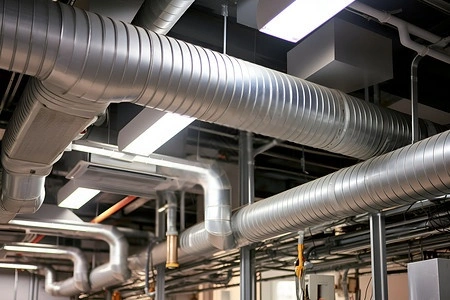
What Are HVAC Duct Fittings?
Duct fittings are standardized metal accessory parts used for connecting, turning, branching, reducing, and sealing ventilation ducts. Mainly made of premium galvanized steel, aluminum, or stainless steel, they adapt to round and rectangular duct systems of all specifications. Different from simple straight ducts, duct fittings undertake airflow steering, shunting, converging, and pressure adjustment tasks, solving various layout limitations and airflow problems in complex building mechanical spaces.
All our duct fittings are manufactured in strict accordance with international HVAC engineering standards, featuring high air tightness, low wind resistance, anti-corrosion durability, and easy modular installation. They support customized sizes and special-shaped processing to meet diversified project construction demands.
Main Types & Core Functions of Duct Fittings
-
Duct Elbows Available in 45° and 90° standard angles, divided into smooth radius elbows and vane elbows. Used to change airflow direction in limited ceiling spaces. Optimized aerodynamic design effectively reduces airflow turbulence and pressure loss, avoiding excessive wind noise and resistance surge caused by sharp turning. Widely used for vertical and horizontal duct turning in all ventilation systems.
-
Duct Tees & Wyes Core components for airflow branching and confluence. Tees realize vertical 90° shunting of main duct airflow, while wyes adopt smooth oblique branch structure with lower wind resistance. They evenly distribute air volume to multiple branch pipelines, solving zoning air supply and return problems and ensuring balanced air volume in each functional area.
-
Duct Reducers & Transitions Including concentric reducers, eccentric reducers, and round-to-rectangle transition fittings. Applied at duct diameter conversion and equipment connection positions. They smoothly adjust duct cross-sectional area, stabilize wind speed and static pressure, prevent sudden airflow fluctuation, and ensure seamless connection between ducts and fans, air boxes, and terminal equipment.
-
Duct Couplings & Connectors Used for butt connection of straight duct sections. Adopt precise bite and sealing technology to ensure tight duct splicing. Effectively prevent air leakage at joints, improve overall system air tightness, and avoid cooling/heating energy loss caused by pipeline gaps.
-
Duct End Caps & Plugs Seal unused duct openings and reserved pipe ends. Prevent dust, debris, and moisture from entering the duct system during construction and long-term operation, keeping internal pipelines clean and avoiding system blockage and pollution.
-
Special-Shaped Custom Fittings Including saddle taps, cross joints, offset adapters, and reinforced pipe fittings. Suitable for complex on-site working conditions such as old building renovation, limited space transformation, and special duct layout, solving personalized construction difficulties.
Key Engineering Advantages of Standard Duct Fittings
-
Stable Airflow & Balanced Zoning Air Volume Scientific structural design optimizes airflow operation path, reduces turbulence and eddy current loss, ensures uniform air supply and return in each room and zone, avoids local over-cooling or insufficient air volume, and improves overall HVAC comfort.
-
High Air Tightness & Energy Saving Precision manufacturing and standardized installation effectively reduce duct air leakage rate. Lock cold and heat energy loss, reduce fan load and unit operating time, and significantly lower long-term building energy consumption and operation costs.
-
Low Wind Resistance & Low Noise Operation Aerodynamic optimized fittings minimize airflow impact and duct resonance noise. Maintain smooth system operation, reduce HVAC background noise, and meet ultra-quiet environmental requirements of high-standard buildings.
-
Durable Anti-Corrosion Structure Adopt thickened galvanized steel or stainless steel materials, with excellent rust-proof, anti-corrosion, and oxidation resistance. Adapt to humid, high-temperature, and long-cycle continuous operation environments, with long service life and low failure rate.
-
Modular & Efficient Installation Standardized size design realizes fast assembly and on-site cutting-free construction. Shorten engineering cycle, reduce manual construction errors, and improve project acceptance pass rate.
-
Full System Compatibility Perfectly matched with fire dampers, sound attenuation elbows, static pressure boxes, IRIS dampers, and other HVAC accessories. Support unified system integration and form a complete high-efficiency ventilation solution.
Main Industrial & Commercial Application Scenarios
Duct fittings are essential basic components for all ventilation and air conditioning systems, covering commercial buildings, public facilities, industrial plants, and special engineering projects:
1. Commercial Building HVAC Systems
Widely used in central air conditioning duct systems of office buildings, shopping malls, hotels, and apartments. Complete sets of standard duct fittings realize reasonable layout of ceiling hidden ducts, ensure balanced indoor air supply, stable temperature control, and low-noise operation, meeting high-comfort commercial building operation standards.
2. Public & Cultural Venues
Suitable for schools, libraries, exhibition halls, gymnasiums, and hospital buildings. Standardized duct shunting and steering ensure uniform ventilation in large-space areas, avoid local dead air zones, and meet public building safety and comfort requirements.
3. Industrial Plant Ventilation & Exhaust
Applied to factory dust removal exhaust, process cooling, and fresh air delivery systems. High-strength anti-corrosion duct fittings adapt to industrial high-dust and humid environments, ensure long-term stable operation of ventilation pipelines, and improve workshop production environment.
4. Cleanroom & Laboratory Engineering
Dust-free workshops, pharmaceutical clean rooms, and scientific research laboratories require high air tightness and clean ventilation systems. High-precision sealed duct fittings avoid air leakage and dust accumulation, ensure stable indoor air pressure and cleanliness indicators, and meet high-standard purification engineering requirements.
5. Old Building HVAC Renovation Projects
Custom special-shaped duct fittings solve the problems of irregular pipeline layout and limited space in old building renovation. Without large-scale demolition and reconstruction, they realize efficient upgrading and optimization of old ventilation systems.
Common Problems Caused by Low-Quality Duct Fittings
-
Severe Duct Air Leakage: Poor sealing leads to energy loss and reduced air supply efficiency
-
Unbalanced Zoning Air Volume: Unreasonable fitting structure causes uneven indoor temperature
-
Increased System Wind Noise: Turbulent airflow generates persistent wind noise and resonance
-
Shortened System Service Life: Inferior materials are prone to rust and deformation, causing pipeline failure
-
Failed Project Acceptance: Substandard air tightness and airflow parameters affect project delivery
Why Choose Our HVAC Duct Fittings?
-
Full Product Range: Complete series of elbows, tees, reducers, couplings and custom fittings
-
Premium Industrial Materials: Galvanized steel, aluminum, stainless steel optional, durable and anti-corrosion
-
Aerodynamic Optimization Design: Low wind resistance, low noise, stable airflow performance
-
High Air Tightness Standard: Strict sealing process to minimize system air leakage
-
Standard & Custom Sizes: Support mass standard products and personalized customization
-
Full Export Service: Complete test reports and certification documents for global projects
Final Thoughts
Duct fittings are the invisible core guarantee for efficient operation of HVAC ventilation systems. Standardized, high-quality duct fittings optimize airflow routes, balance system air volume, reduce energy consumption and noise, and improve the overall stability and comfort of air conditioning and ventilation systems. They are basic and indispensable supporting accessories for all commercial and industrial HVAC engineering projects.