
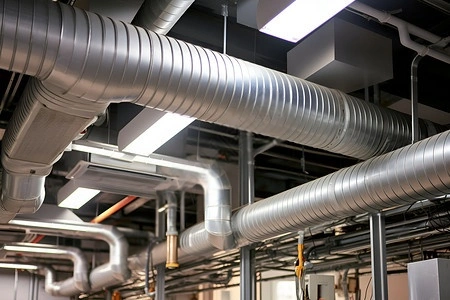
1. Introduction: The Critical Role of Air Ducts in HVAC Systems
A complete HVAC system consists of fans, heat exchange equipment, filter devices, and air duct systems. While fans provide power for air flow, air ducts are the carrier that delivers conditioned air to every indoor area. High-quality air duct layout and product selection can minimize air leakage, reduce heat loss, lower ventilation resistance, and suppress airflow noise.
With the upgrading of building energy-saving standards and fire safety codes, ordinary single-function ducts can no longer meet diversified engineering demands. Currently, square ducts, spiral ducts, and fireproof & thermal insulation composite ducts have become the three mainstream choices in the HVAC industry. Each has unique structural advantages and applicable scenarios in terms of installation adaptability, airtightness, safety, and energy efficiency.
2. Square Ducts: Classic & Space-Saving HVAC Air Pipeline Solution
2.1 Product Features
Square ducts, also known as rectangular ducts, are the most traditional and widely adopted duct type in HVAC engineering. Manufactured by galvanized steel sheet, stainless steel, or color steel plate, they feature a regular rectangular cross-section, standardized splicing structure, and flexible size customization. The overall structure is flat and neat, with strong adaptability to building ceiling layouts.
2.2 Core Advantages
-
Excellent space adaptability: The flat rectangular structure fits closely with building beams and ceilings, making full use of narrow installation space and reducing ceiling height occupation.
-
Flexible size customization: Supports arbitrary size adjustment according to on-site airflow demand and space constraints, suitable for personalized engineering layout.
-
Stable structure & easy sealing: Standard flange connection ensures good overall rigidity, effectively reducing air leakage and improving HVAC air supply accuracy.
-
Convenient construction & maintenance: Simple installation process, easy opening of air outlets and inspection ports, low later maintenance cost.
2.3 HVAC Application Scenarios
Square ducts are widely used in large and medium-sized central air conditioning ventilation systems. They are the preferred choice for indoor main and branch air ducts of office buildings, shopping malls, hotels, hospitals, and exhibition halls. In scenarios with complex ceiling structures and dense pipelines, square ducts can realize orderly layout of air supply, return air, and exhaust systems. In addition, they are also commonly used for factory workshop ventilation and dust removal, underground garage exhaust, and large-space fresh air circulation projects.
3. Spiral Ducts: High-Airtight & Low-Resistance Round Air Ducts
3.1 Product Features
Spiral ducts are round air ducts formed by spiral rolling and seamless biting of metal strips. Compared with traditional square ducts, they have a smooth integral circular pipe body without splicing dead angles. The spiral reinforced structure improves the overall compression resistance and structural stability of the duct.
3.2 Core Advantages
-
Ultra-low air leakage rate: Integral seamless rolling molding effectively avoids air leakage at splicing gaps, greatly improving HVAC system operation efficiency and saving energy consumption.
-
Low airflow resistance & low noise: The smooth inner wall reduces airflow friction and turbulence, lowering ventilation noise and fan operating load.
-
High structural strength: Spiral rib reinforcement enhances pressure resistance, not easy to deform under positive and negative air pressure.
-
Fast installation & beautiful appearance: Integrated pipe body reduces connecting parts, shortens construction period, and the neat round shape is suitable for exposed installation scenarios.
3.3 HVAC Application Scenarios
Spiral ducts are ideal for high-efficiency and low-noise HVAC ventilation systems. They are widely used in subway ventilation, underground comprehensive pipe galleries, supermarket central air conditioning, factory dust removal and exhaust, and building fire smoke exhaust systems. Especially for long-distance straight-line air supply pipelines and exposed ventilation projects that require high appearance, spiral ducts show irreplaceable advantages. They are also commonly used in gymnasiums, station waiting halls, and other large-space ventilation scenarios.
4. Fireproof & Thermal Insulation Ducts: Safety & Energy-Saving Integrated Ducts
4.1 Product Features
Fireproof and thermal insulation ducts are new composite functional ducts integrating fire resistance, heat preservation, heat insulation, and anti-condensation functions. The mainstream products include composite fireproof board ducts, thermal insulation cloth wrapped metal ducts, and integrated fire-resistant thermal insulation ducts. The internal and external layers have fireproof and thermal insulation materials, which can block heat conduction and prevent flame spread.
4.2 Core Advantages
-
Excellent fire safety performance: Meet national building fire protection standards, effectively block fire and smoke spread, improve building fire safety redundancy.
-
Superior thermal insulation & energy saving: Isolate internal and external temperature heat transfer, avoid cold loss and heat loss of conditioned air, and reduce HVAC long-term operating costs.
-
Anti-condensation & anti-corrosion: Prevent pipeline condensation water from dripping, avoid mildew and corrosion of ducts and ceilings, and extend service life.
-
Integrated design & labor-saving construction: No secondary thermal insulation wrapping required on site, simplifying the construction process and shortening the project cycle.
4.3 HVAC Application Scenarios
Fireproof and thermal insulation ducts are mandatory supporting products for high-standard building HVAC systems. They are mainly used for fire smoke exhaust pipelines, positive pressure air supply pipelines, and central air conditioning main ducts in high-rise buildings, commercial complexes, medical institutions, and data centers. In special scenarios such as constant temperature and humidity workshops, clean rooms, and cold storage ventilation systems, these ducts can effectively guarantee the stability of indoor temperature and humidity, while meeting fire safety acceptance standards, which is an essential part of high-quality HVAC engineering.
5. HVAC Air Duct Selection Guide for Engineering Projects
Reasonable duct selection is the premise of efficient and safe operation of HVAC systems. Engineers and purchasers can make targeted selection according to project scenarios:
-
Choose Square Ducts: For indoor concealed ceiling pipelines, projects with limited installation height, and complex multi-branch ventilation systems that require flexible size matching.
-
Choose Spiral Ducts: For long-distance straight ventilation, exposed installation projects, and scenarios requiring low air leakage, low noise and high ventilation efficiency.
-
Choose Fireproof & Thermal Insulation Ducts: For high-rise building smoke exhaust and air supply, constant temperature and humidity clean workshops, and all projects with fire protection and energy-saving acceptance requirements.
6. Conclusion
Square ducts, spiral ducts, and fireproof & thermal insulation ducts have their own unique positioning in the HVAC industry. Square ducts focus on space adaptation and flexible layout, spiral ducts focus on high efficiency and low leakage ventilation, and functional fireproof thermal insulation ducts focus on building safety and energy-saving operation. As building energy-saving and fire protection requirements continue to improve, diversified and customized air duct solutions have become the mainstream trend of HVAC engineering.
We provide full-series HVAC air duct products and customized engineering solutions to meet the ventilation demands of commercial, industrial, and civil construction projects. If you have duct selection, scheme design, and bulk procurement needs, welcome to contact our professional team for one-stop technical support and quotation services.