
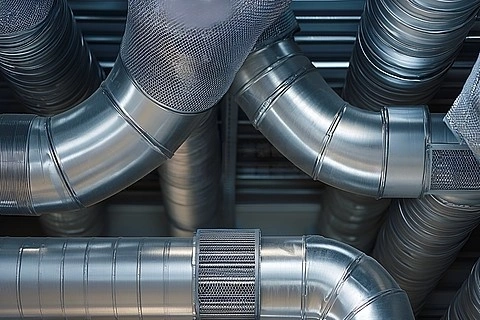
What Are Air Valves & Dampers Used For?
Air dampers are mechanical devices installed inside ventilation ducts, air outlets, and HVAC units. They control airflow direction, adjust air volume, block backflow, and isolate fire and smoke hazards. From residential ventilation and commercial buildings to factory industrial systems, air valves and dampers are mandatory accessories to ensure ventilation system stability, safety, and standard compliance.
Main Types of HVAC Air Dampers & Their Applications
1. Non-Return Damper (Backflow Prevention Damper)
A non-return damper, also known as a check damper, is a one-way airflow control device designed to prevent air backflow in ventilation ducts. The damper blades open automatically under positive airflow pressure and close tightly when airflow stops or reverse pressure occurs, effectively blocking reverse air, dust, odor, and wind from flowing back into the system.
Key Features
-
Automatic one-way operation, no manual or electric control required
-
Flexible blade movement, sensitive opening and closing
-
Air-tight sealing design, zero air leakage when closed
-
Durable galvanized steel or stainless steel material, anti-rust and long service life
Common Applications
Non-return dampers are widely used for exhaust fans, fresh air ventilation systems, bathroom and kitchen ductwork, industrial exhaust pipelines, and centralized ventilation systems. They are the most cost-effective solution to avoid odor backflow and cross-air pollution in daily ventilation scenarios.
2. Volume Control Damper (VCD)
Volume Control Dampers (VCD) are the most commonly used airflow regulation dampers in professional HVAC systems. Equipped with multi-layer adjustable blades and manual or electric actuators, these dampers can precisely adjust the opening degree of duct blades to control and balance airflow volume, wind speed, and air pressure in each ventilation branch.
Unlike non-return dampers that only serve single-direction blocking, VCDs support stepless airflow adjustment, allowing engineers to balance the entire building’s air supply and exhaust system for uniform and stable ventilation performance.
Key Features
-
Precise manual/electric airflow regulation
-
High airtightness, low wind resistance, no airflow noise
-
Easy on-site adjustment and system debugging
-
Customizable sizes to match all duct dimensions
Common Applications
Ideal for central air conditioning systems, office buildings, shopping malls, hotels, schools, and large commercial ventilation projects. Volume control dampers are essential for HVAC system commissioning and airflow balance management.
3. IRIS Damper (Round Airflow Regulating Damper)
IRIS dampers are professional circular variable air volume dampers, famous for theiriris-type aperture adjustment structure. Different from traditional blade-type volume dampers, IRIS dampers adopt a rotating iris mechanism to achieve precise, stepless adjustment of duct cross-section area, realizing ultra-accurate airflow control.
With compact structure, beautiful appearance, and extremely high adjustment accuracy, IRIS dampers solve the problem of uneven airflow and low precision of traditional dampers, becoming the preferred choice for high-precision ventilation systems.
Key Features
-
Iris-type precise airflow adjustment with high control accuracy
-
Round duct matching design, perfect airtight fit
-
Smooth operation, no airflow turbulence or noise
-
Lightweight, easy installation and maintenance
Common Applications
Widely used in laboratory ventilation, clean room air conditioning, hospital operating rooms, precision workshop ventilation, and high-end commercial building round duct systems. It is specially suitable for scenarios requiring strict airflow and wind speed control.
4. Fire Damper (Fire & Smoke Isolation Damper)
Fire dampers are safety-grade HVAC components focused on fire prevention and smoke control. Installed in ventilation and air conditioning ducts that pass through building fire partitions, fire dampers will automatically close when the ambient temperature reaches the standard threshold, cutting off the duct passage to prevent fire and smoke from spreading across floors and fire zones.
As a mandatory fire safety component for building engineering, fire dampers comply with international fire protection codes and are critical for building fire hazard prevention and personnel safety protection.
Key Features
-
Automatic temperature sensing and closing, reliable fire isolation
-
High-temperature resistant metal structure, flame retardant and smoke proof
-
Meet international building fire safety standards
-
Available in manual reset and electric control types
Common Applications
Mandatory installation for high-rise buildings, shopping centers, subway stations, industrial workshops, hospitals, and all public building ventilation duct systems. Fire dampers are non-negotiable for project fire acceptance and safety compliance.
How to Choose the Right Air Dampers for Your Projects?
Each type of air damper serves a unique function, and reasonable matching can maximize ventilation system efficiency and safety:
-
Anti-backflow needs: Choose Non-return Dampers
-
System airflow balance & adjustment: Choose Volume Control Dampers
-
High-precision airflow control for round ducts: Choose IRIS Dampers
-
Building fire safety protection: Choose Fire Dampers
Why Source Our Air Valves & Dampers?
-
Full Product Line: Complete series including non-return, volume control, IRIS, and fire dampers for one-stop procurement
-
Strict Quality Control: All dampers adopt high-quality metal materials, with tight sealing, flexible operation, and long service life
-
Standard Compliance: Products meet international HVAC and fire safety standards, suitable for global engineering projects
-
Custom Support: Custom sizes and electric/manual types to fit personalized duct system requirements
-
Factory Direct Supply: Competitive wholesale price, stable delivery, and professional technical support
Final Thoughts
Air valves and dampers are the guarantee of efficient, stable, and safe operation of all HVAC and ventilation systems. Selecting professional and qualified dampers can effectively improve ventilation efficiency, reduce energy consumption, and avoid potential safety hazards.
Whether you are a distributor looking for bulk wholesale products or a contractor needing customized damper solutions for engineering projects, we can provide you with high-quality products, favorable prices, and reliable after-sales service. Contact us today to get your free catalog and wholesale quotation!