
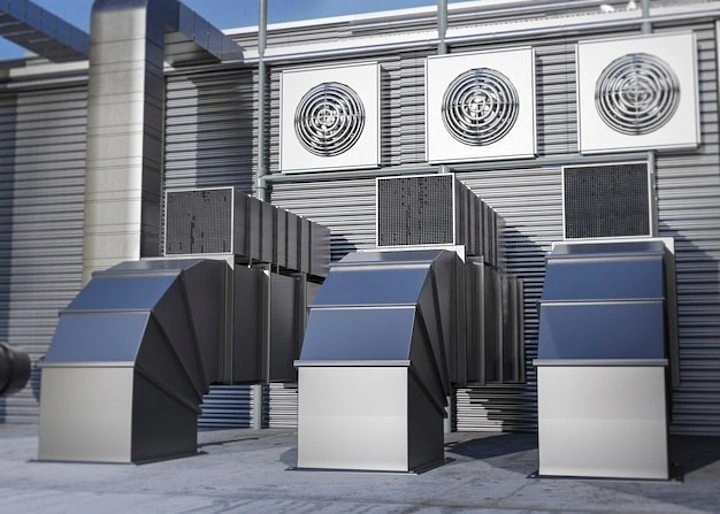
What Is a Centrifugal Fan?
A centrifugal fan, also known as a squirrel-cage fan, is a mechanical air device that uses centrifugal force to generate airflow. Unlike axial fans that move air parallel to the fan shaft, centrifugal fans draw air axially and discharge it perpendicularly through rotating impellers.
This unique air conversion structure enables centrifugal fans to generate high static pressure, strong wind power, and stable airflow. They are specially built for systems with long duct runs, multiple bends, filters, and high air resistance — making them the core power source for professional HVAC air handling systems.
Core Advantages of Centrifugal Fans in HVAC Systems
Centrifugal fans are widely recognized in the HVAC industry for their superior performance compared to conventional axial fans in complex engineering scenarios. Their key strengths are as follows:
-
High Static Pressure for Complex Ductwork Centrifugal fans deliver powerful static pressure to overcome high resistance from long ducts, multiple elbows, heat exchangers, and filter networks. They ensure stable air supply even in complex and layered HVAC pipeline systems.
-
Precise Air Volume & Pressure Control Matched with speed regulators and VAV systems, centrifugal fans support stepless airflow adjustment. They can precisely balance air volume for different functional zones, meeting strict HVAC air balance and constant-temperature ventilation requirements.
-
Low Vibration & Quiet Operation Equipped with precision dynamic balance impellers and shock-absorbing structures, centrifugal fans run smoothly with minimal turbulence noise. They fully comply with low-noise standards for commercial buildings, hospitals, and office spaces.
-
Strong Dust & Corrosion Resistance Customizable impeller materials including galvanized steel, stainless steel, and anti-corrosion plastic enable stable operation in dusty, humid, and corrosive industrial environments.
-
High Energy Efficiency & Durability Aerodynamically optimized impeller design reduces energy loss. High-quality motors ensure continuous long-term operation, lowering overall energy consumption and maintenance frequency for HVAC systems.
Key HVAC Applications of Centrifugal Fans
Centrifugal fans focus on high-pressure, high-precision, and high-resistance ventilation scenarios. They are the preferred solution for mid-to-high-end commercial HVAC and industrial air handling systems:
1. Air Handling Unit (AHU) & FCU Systems
Centrifugal fans are the core components of air handling units and fan coil units. They provide stable pressure to push air through multi-layer filters, evaporators, and heat exchangers, realizing air purification, temperature adjustment, and centralized air supply. This is the most typical application of centrifugal fans in commercial central air conditioning systems.
Applicable scenarios: Office buildings, shopping malls, hotels, high-rise commercial buildings, and clean room air conditioning systems.
2. Long-Distance Duct Air Supply & Exhaust
For large buildings with ultra-long ductwork and multi-branch pipelines, ordinary axial fans cannot overcome pipeline resistance, resulting in insufficient air supply. Centrifugal fans with high static pressure perfectly solve this problem, ensuring uniform and stable air delivery for far-end ventilation points.
3. Clean Room & Laboratory Ventilation
Dust-free workshops, medical clean rooms, and scientific laboratories require continuous filtered air circulation and precise positive/negative pressure control. Centrifugal fans support stable air circulation through high-density filter screens, maintaining indoor air cleanliness and pressure balance to meet industrial and medical grade standards.
4. Industrial Dust Removal & Exhaust Systems
In industrial production scenarios, centrifugal fans can continuously extract dust, smoke, oil fume, and harmful gas. With high suction power and stable air pressure, they are widely matched with dust collectors and industrial exhaust equipment to improve workshop operating environments.
Applicable scenarios: Woodworking factories, metal processing workshops, chemical plants, and pharmaceutical factories.
5. Heat Recovery & Fresh Air Ventilation Systems
Heat recovery ventilation (HRV) and energy recovery ventilation (ERV) systems rely on centrifugal fans to complete bidirectional air exchange. Their stable air pressure ensures efficient heat exchange and fresh air delivery, helping buildings achieve energy-saving ventilation and indoor air quality improvement.
6. Smoke Exhaust & Pressurization Ventilation
Fire-rated centrifugal fans are used for building stairwell pressurization and large-area smoke exhaust. They provide stable air pressure to form positive pressure isolation and quickly discharge smoke, meeting fire safety specifications for high-rise buildings and public infrastructure.
Centrifugal Fan vs Axial Fan: Quick Selection Guide
To avoid wrong model selection in HVAC projects, here is a simple and clear comparison for global buyers and contractors:
-
Axial Fan: Best for low resistance, large air volume scenarios — basic exhaust, heat dissipation, and open-space air circulation.
-
Centrifugal Fan: Best for high resistance, long duct, precise air control scenarios — central air conditioning, clean rooms, and industrial air handling systems.
Why Choose Our HVAC Centrifugal Fans?
-
High Static Pressure & Stable Performance: Professionally optimized impeller structure ensures strong air pressure and no air volume attenuation in complex ducts
-
Multiple Custom Options: Support different materials, speeds, air volumes, and fire-proof/explosion-proof grades for customized project needs
-
Strict Quality Standards: Dynamic balance testing, low noise operation, and long continuous service life
-
Wide Compatibility: Perfectly matched with AHUs, FCUs, dust removal systems, and all mainstream HVAC duct accessories
-
Factory Direct Wholesale: Cost-effective pricing, stable bulk supply, and professional overseas project technical support
Final Thoughts
Centrifugal fans are the backbone of high-end and high-performance HVAC ventilation systems. Their unique high-pressure performance makes them irreplaceable for complex ductwork, clean air handling, and industrial ventilation projects. Choosing high-quality centrifugal fans directly improves HVAC system efficiency, reduces energy waste, and ensures long-term stable operation.