
Introduction
To most building owners and even junior HVAC technicians, air diffusers are often mistaken for simple decorative ceiling grilles. In fact, they are precision-engineered terminal devices that dominate how conditioned supply air distributes, mixes, and circulates within a room.
In high-demand commercial environments—including corporate offices, hotels, hospitals, schools, and shopping malls—poor diffuser selection triggers a series of operational problems. Improperly matched diffusers cause uneven hot and cold spots, persistent stuffy zones, frequent occupant noise complaints, and increased HVAC running loads, ultimately driving up monthly utility bills. Conversely, a well-selected air diffuser enables uniform indoor temperature distribution, efficient air exchange and mixing, and ultra-quiet operation, maximizing the overall performance of the entire HVAC system.
With a wide variety of diffuser types, sizes, and specifications on the market, how to make a scientific, reasonable, and cost-effective choice? This guide breaks down diffuser classifications, core selection standards, scenario-based matching rules, and industry best practices to help engineers and facility managers avoid blind selection and hidden operational risks.
1. Four Main Types of Commercial Air Diffusers & Core Applications
The biggest difference between various air diffusers lies in their airflow discharge patterns and induction mixing capabilities. Ceiling height, room area, and functional attributes directly determine the most suitable diffuser type. The four most widely used commercial diffusers and their matching scenarios are summarized below.
| Diffuser Type | Best Application Scenarios | Airflow Pattern Characteristics |
|---|---|---|
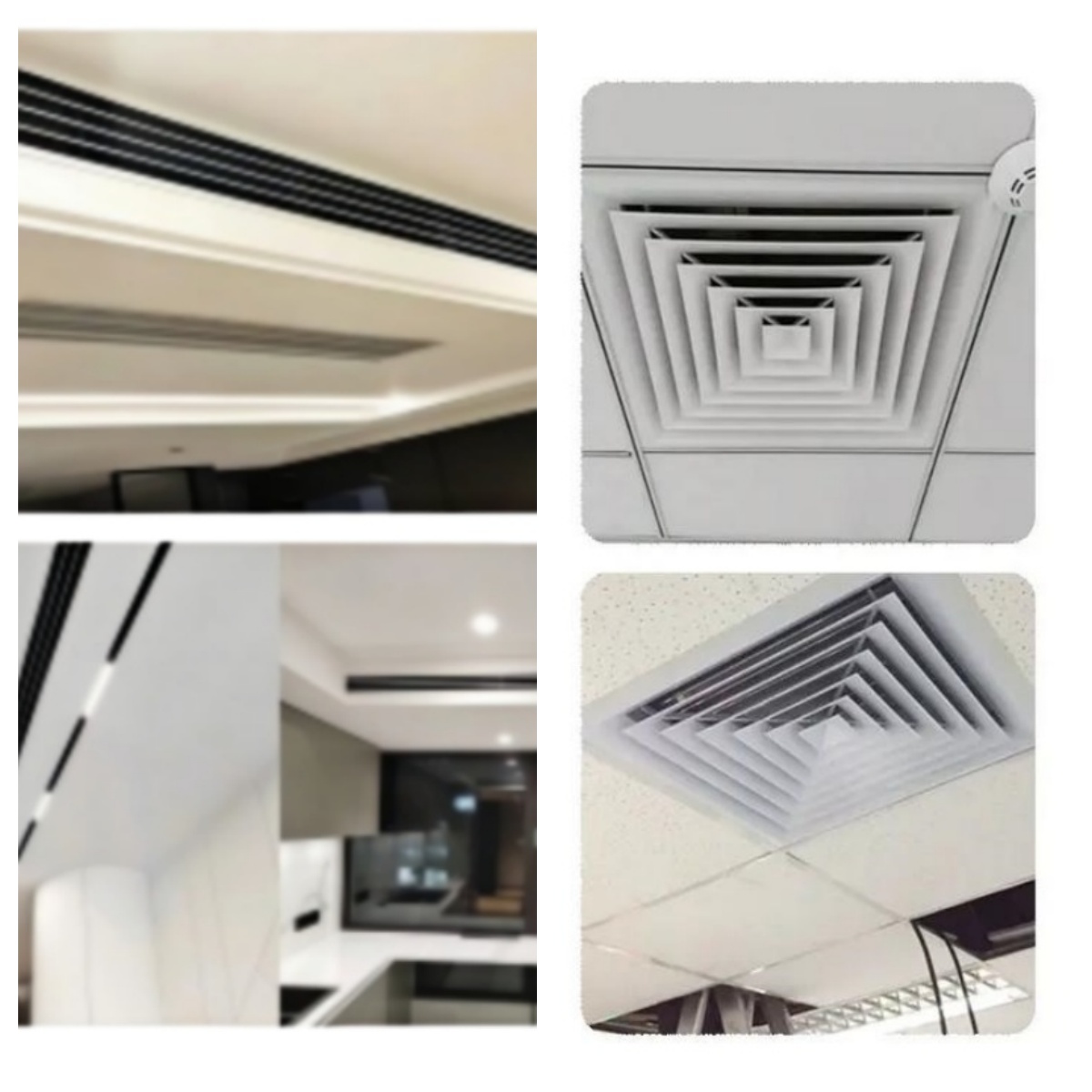
| Square/Rectangular Ceiling Diffuser | Standard offices, conference rooms, retail stores, and most conventional commercial spaces | Supports 4-way horizontal or vertical air discharge with flexible airflow throw, stable air distribution, and strong adaptability to regular ceiling layouts |
| Linear Slot Diffuser | Modern architectural spaces, long corridors, building perimeter zones, and minimalist decoration-style venues | Single-slot or multi-slot linear air supply, connectable to ductwork or plenum boxes; can be spliced into long continuous sections for integrated air supply |
| Swirl / Vortex Diffuser | High-ceiling spaces: building atriums, lobby halls, auditoriums, and exhibition halls | Forms rotational swirling airflow, features high air induction and rapid mixing, effectively solves the problem of slow air circulation in high spaces |
| Jet / Nozzle Diffuser | Super-large spaces: industrial factories, indoor sports halls, large exhibition centers | Outputs concentrated long-throw air streams, capable of covering ultra-long distances to meet ventilation demands of large-area open spaces |
Practical Industry Example: For a standard open-plan office with a 2.7m (9ft) ceiling height, a 600×600mm square ceiling diffuser equipped with an opposed blade damper and 4-way air throw is the most reliable and cost-effective conventional solution, balancing comfort, air supply efficiency, and later maintenance convenience.
2. Five Must-Check Core Diffuser Selection Criteria
Appearance and size are not the main basis for selection. Professional diffuser matching needs to focus on five core performance indicators to ensure coordination with HVAC system operation and indoor environmental requirements.
2.1 Airflow Pattern & Throw Distance
Air throw refers to the maximum distance that supply air travels horizontally before the wind speed drops to 0.25m/s (50fpm), which is the core indicator to judge air coverage efficiency. Large-area open spaces require long-throw diffusers to avoid central air stagnation; small independent offices and cubicles are suitable for short-throw air supply to prevent excessive wind speed.
It is necessary to avoid the “air dumping” problem where cold air falls directly on occupants. For conventional spaces, ceiling diffusers with horizontal air discharge or swirl diffusers with high induction mixing should be prioritized to achieve gentle and uniform air circulation.
2.2 Noise Criterion (NC Level)
Indoor acoustic comfort is a key evaluation standard for commercial HVAC systems. Most office, retail, and hotel spaces require a noise standard of NC 25–35. Under the same airflow volume and operating conditions, reasonably sized linear slot diffusers deliver quieter operation than traditional square diffusers.
During selection, do not rely on subjective experience. It is essential to refer to the NC parameter data published by manufacturers, which corresponds to actual airflow (L/s or CFM) and static pressure working conditions, to ensure the actual operating noise meets design standards.
2.3 Static Pressure Drop
Diffuser pressure drop is closely linked to building energy consumption. A high static pressure drop means the HVAC fan needs to overcome greater resistance, resulting in increased fan load, higher power consumption, and long-term energy waste.
For conventional commercial projects, it is recommended to select low-resistance diffusers with a static pressure drop below 20Pa under design airflow conditions to maintain efficient and low-energy operation of the air supply system.
2.4 Adjustability & Damper Performance
Independent opposed blade dampers are essential configurations for high-quality diffusers. They support independent airflow balancing for each room and each zone, facilitating precise debugging and later operation adjustment of the HVAC system.
For VAV (Variable Air Volume) systems commonly used in commercial buildings, priority should be given to diffusers with stable throw performance in a wide flow range, with a turn-down ratio of 4:1 or higher, to ensure consistent air supply effect under variable load conditions.
2.5 Aesthetics & Architectural Integration
As terminal equipment exposed in indoor spaces, diffusers need to match the overall architectural decoration style. Conventional white, silver, and customized RAL color finishes can be matched with various ceiling tile materials and colors. Linear slot diffusers can be spliced into continuous sections up to 3 meters long, presenting a sleek, minimalist overall effect, which is very suitable for modern commercial buildings with high aesthetic requirements.
3. Scenario-Based Diffuser Matching Guide for Typical Commercial Spaces
Different functional spaces have distinct demands for air volume, wind speed, noise, and air cleanliness. The following targeted matching schemes cover mainstream commercial scenarios, providing direct reference for design and renovation projects.
| Room Type | Recommended Diffuser Type | Matching Reason & Advantages |
|---|---|---|
| Private Office (12–20㎡) | 300×300mm Square Ceiling Diffuser | Features short and gentle air throw, ultra-low operating noise, flexible airflow balancing, fully adapting to small-space office comfort needs |
| Open Plan Office (Over 50㎡) | 600×600mm Modular Square Diffuser / Window-side Linear Slot Diffuser | Uniformly mixes indoor air, effectively offsets heat and cold loss at building perimeters, eliminates local hot and cold spots in large open spaces |
| High-Ceiling Conference Room (Ceiling ≥3m) | Swirl Diffuser | High induction swirling airflow realizes rapid air mixing, no direct drafts, and uniform indoor temperature, improving meeting comfort |
| Hospital Patient Room | Low-Velocity Linear Slot Diffuser / Displacement Diffuser | Minimizes indoor air turbulence, avoids air cross-contamination, meets the high air quality and safety standards of medical spaces |
| Retail Store & Mall Corridor | Continuous Linear Slot Diffuser | Integrated and beautiful appearance, compatible with lighting and other ceiling facilities, stable air supply and low noise, suitable for high-foot-traffic commercial public areas |
4. Three Common Diffuser Selection Mistakes to Avoid
In actual engineering design and retrofitting, unreasonable selection often leads to substandard system operation. The three most common mistakes are summarized as follows:
1. Excessive diffuser sizing: An oversized diffuser matched with low design airflow will produce slow “creeping air” that cannot form effective indoor circulation, resulting in long-term air stagnation and stuffy indoor environments.
2. Ignoring terminal wind speed control: When the air supply terminal wind speed exceeds 0.2m/s (40fpm), direct blowing on occupants will cause obvious draft sensation, triggering frequent comfort complaints.
3. Mismatched supply and return air positions: If supply diffusers are too close to return air grilles, air short-circuiting will occur—conditioned air is directly discharged without indoor circulation. It is recommended to maintain a spacing of 2–3 meters between supply and return ports.
5. Standard Step-by-Step Diffuser Selection Process
For HVAC engineers and facility managers, standardized selection procedures can effectively avoid errors and optimize system performance. The complete process is as follows:
Step 1: Calculate the cooling and heating load of each functional zone to determine the required design supply air volume.
Step 2: Select the diffuser type according to room ceiling height, personnel density, functional attributes, and architectural aesthetic requirements.
Step 3: Refer to manufacturer technical catalogs to select diffuser specifications, and verify core parameters including airflow throw, NC noise level, and static pressure drop under design working conditions.
Step 4: Conduct noise check to ensure that the NC value under maximum airflow operation is lower than the space design standard.
Step 5: Optimize the layout spacing of diffusers. The installation spacing is controlled at 1.5–2 times the airflow throw distance to eliminate indoor air stagnation zones.
Step 6: Uniformly configure opposed blade dampers for all diffusers to reserve adjustable space for later system airflow balancing and debugging.
Professional Pro Tip: For high-standard key spaces such as hospital operating rooms, clean rooms, and super-high atriums, it is recommended to use CFD simulation analysis or manufacturer’s professional online selection software for accurate matching to ensure system stability.
Conclusion
Commercial air diffuser selection is a comprehensive design work that balances aerodynamic performance, acoustic effect, energy efficiency, and architectural aesthetics. It is not a simple specification matching work, but a key link related to long-term building operation quality.
The optimal selection logic is always based on room functional attributes and ceiling height, with secondary verification of airflow throw, noise, and pressure drop indicators. Whether it is a new HVAC system design or an old building retrofit, early communication and cooperation between HVAC designers and diffuser manufacturers can effectively avoid hidden dangers such as uneven air supply, excessive noise, and energy waste. A small optimization of diffuser selection can bring long-term improvements in occupant comfort and building energy-saving benefits throughout the entire life cycle of the building.