
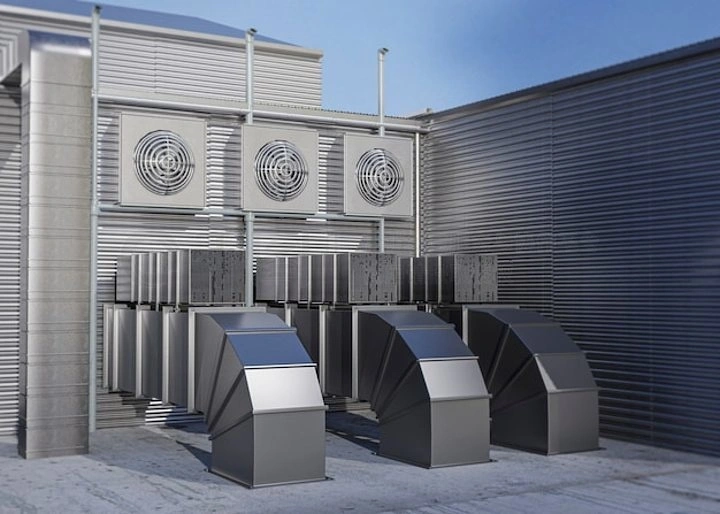
What Is a Mixed Flow Fan?
A mixed flow fan is a hybrid air-moving device that combines the structural and performance characteristics of axial fans and centrifugal fans. Air enters the fan axially and is discharged in a diagonal mixed-flow direction, integrating the large air volume advantage of axial fans and the medium high-pressure performance of centrifugal fans.
Different from pure axial or centrifugal models, mixed flow fans are designed to solve the common HVAC pain point: axial fans lack pressure for medium-resistance ducts, while centrifugal fans are too bulky and costly for regular ventilation. With compact size, balanced airflow and pressure, and low noise output, mixed flow fans are widely used in medium-static-pressure HVAC duct systems.
Core Advantages of Mixed Flow Fans in HVAC Systems
-
Balanced Air Volume & Static Pressure Mixed flow fans deliver higher static pressure than axial fans and larger airflow than centrifugal fans of the same size. They perfectly adapt to medium-resistance duct systems with filters, elbows, and duct fittings, ensuring stable and sufficient air supply.
-
Compact & Space-Saving Structure Compared with bulky centrifugal fan units, mixed flow fans feature a streamlined cylindrical design, easy to install in ceiling ducts, vertical pipelines, and limited mechanical spaces, greatly saving construction layout costs.
-
Low Noise & Smooth Operation Optimized mixed-flow impeller design reduces airflow turbulence and mechanical vibration. The overall operating noise is lower than traditional high-pressure fans, fully meeting the quiet operation requirements of commercial buildings.
-
High Energy Efficiency Aerodynamically optimized blade structure reduces wind resistance and power consumption. Mixed flow fans achieve higher ventilation efficiency with lower energy input, helping HVAC systems run in an energy-saving state for a long time.
-
Flexible Installation & Strong Compatibility Support horizontal, vertical, and ducted installation. Compatible with standard HVAC duct sizes, silencer boxes, dampers, and all conventional duct accessories, realizing seamless system matching.
Key HVAC Applications of Mixed Flow Fans
Mixed flow fans excel in medium-resistance, balanced ventilation scenarios, covering commercial buildings, public facilities, and industrial HVAC systems. Below are their most common engineering applications:
1. Ducted Fresh Air Supply & Exhaust Systems
Mixed flow fans are the preferred fan type for concealed ceiling ducted fresh air systems. They stably overcome the resistance of duct pipelines, elbows, and coarse filters, realizing uniform indoor fresh air delivery and dirty air exhaust. With low noise performance, they will not interfere with indoor working and living environments.
Applicable scenarios: Office buildings, residential central fresh air systems, hotels, shopping malls, and commercial office spaces.
2. Mechanical Ventilation for Public Buildings
Public facilities such as schools, hospitals, subway stations, and exhibition halls require continuous and stable mechanical ventilation. Mixed flow fans provide large-volume air exchange and maintain stable indoor air pressure, effectively improving indoor air quality and avoiding crowded space stuffiness.
3. Smoke Exhaust & Pressurization Ventilation
Fire-rated mixed flow fans are widely used in building smoke exhaust and stairwell pressurization systems. They can maintain stable air volume and air pressure under long-term operation and high-temperature conditions, quickly exhausting smoke and forming positive pressure isolation to ensure personnel evacuation safety.
4. Industrial Workshop Ventilation & Cooling
For industrial workshops with medium ventilation resistance, mixed flow fans efficiently discharge hot air, dust, and slight waste gas. Compared with axial fans, they have stronger pressure resistance and can adapt to simple duct pipe network ventilation, improving workshop working environment and production efficiency.
5. HVAC Air Handling Auxiliary Air Supply
In small and medium-sized air handling systems, mixed flow fans act as auxiliary air supply and circulation power sources. They assist AHU and FCU systems in balancing regional air volume, solving local insufficient air supply and unbalanced temperature distribution problems.
Mixed Flow Fan vs Axial Fan vs Centrifugal Fan: Quick Selection Guide
-
Axial Fan: Best for low resistance, open ventilation — simple exhaust, heat dissipation, open-space air exchange.
-
Centrifugal Fan: Best for high resistance, long-distance ducts — clean rooms, high-precision air handling, complex pipe networks.
-
Mixed Flow Fan: Best for medium resistance, ducted ventilation — fresh air systems, building exhaust, smoke ventilation, and general HVAC duct projects.
Why Choose Our HVAC Mixed Flow Fans?
-
Balanced Professional Performance: Strict dynamic balance testing, stable medium pressure and large air volume, no airflow attenuation
-
Durable Industrial Quality: High-strength impeller and shell, anti-rust, anti-corrosion, long continuous service life
-
Diversified Product Types: Standard ventilation type, fire-resistant type, low-noise type for multiple project demands
-
Easy Installation & High Compatibility: Standard duct size design, perfectly matched with all HVAC duct accessories
-
Factory Direct Wholesale: Cost-effective pricing, stable bulk supply, and professional overseas project technical support
Final Thoughts
Mixed flow fans fill the performance gap between axial fans and centrifugal fans, becoming the most practical and cost-effective solution for most conventional ducted HVAC ventilation projects. Their balanced airflow & pressure, low noise, and space-saving features make them essential equipment for modern building ventilation systems.